Once upon a time, in a small, not so very far from here.
Once upon a time unspecified, in the middle distance of the past, not like thousands and thousands of years ago, but far enough ago that the exact number is not relevant. Definitely not yesterday or any time that we could easily count the days or weeks or months. Before you were born, or perhaps when you were a small child, too young to have any memory of the event. Let’s say one hundred and two years ago.
Once, not so very far, so more than a mile but less than one hundred miles. Maybe between fifty and fifteen miles away, let’s say seventy-six miles.
Of course, the event would not have happened on your doorstep, but it was not so very far from here. The narrative would have taken some time to spread by oral tradition, there being no other means of dissemination other than word of mouth or carrier pigeon, perhaps parchment, carried by galloping rider, for the rich and powerful.
I suppose the timing invites us to speculate about the very nature and temporal proximity of myths and legends. Legendary heroines must, perforce, exist in a fog of mystery. Dorothy may have lived in Kansas, we may pronounce, but she also may have ended her days as a shop keeper in Boston. We might conclude that King Arthur’s world outlook owed a lot to the fading remnants of the Roman empire etc.
We must place the events in a timeline shrouded in mist, maybe and undefined circumstance. The location, not so very far, has aspects of many known places, but no conclusive characteristics. It might help if several place names are associated with the event and legend, locations that are sufficiently far apart to promote discussion and therefore mystery is inevitable.
Our narrator tells us that it was in a small. We immediately think town, as that is the most common, but it could easily mean country, ravine or basket. Who can tell?
As it is not far from here, it must be at least a bit like some place that we know. Not too foreign, not so alien, so that we are not scared or bemused and can surround the event, in our imagination at least, with a comfortably familiar back drop.
It only happened once, it was a very specific event and also it was very special, so it couldn’t have happened twice. Notable events only happen once. If it happened more than once we might say, Many times upon a time or Twice upon a time, depending, of course, how many times it had happened,
As an example one might say, It happened one hundred times, so it is quite a common event, I wont bore you with the story, as I expect you’ve already heard all about it.
Anyway, be that as it may, once upon a time not so very far from here, she Sphinx invented an elixir, or was it a healing unguent or potion? In her workshop.
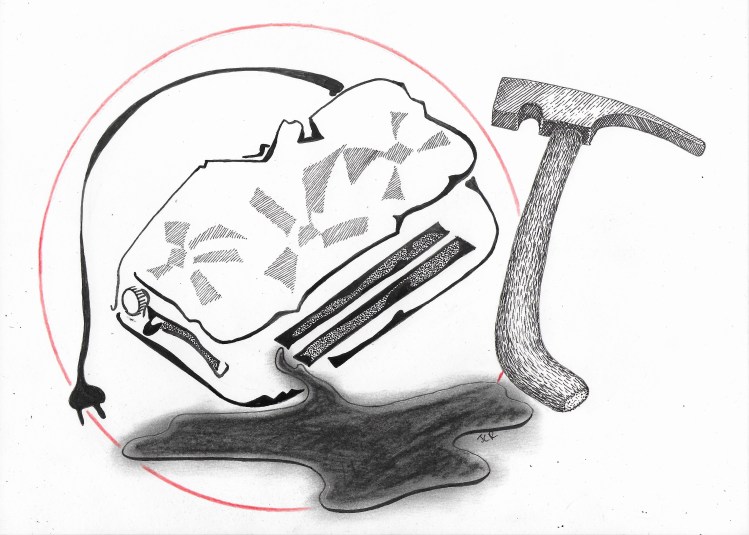
Her intention had been to fix the toaster, which, having ceased toasting, was causing breakfast delays. She had assembled a fine collection of hammers, ranged in no particular order across the bench, beneath a shelf of exhibits. Choosing a geologist’s rock hammer and picking her spot, she smote the toaster thrice in quick succession. The toaster or was it an air fryer, suddenly exuded a golden liquid which perfumed the air with the scent of sweet meadow flowers.
I may not have saved the toaster, said the Sphinx, addressing her hammer, but I have produced the Elixir of Eternal Flowers.
 The Guardians of the Cave